What is an Evaporator?
An evaporator is a vital component in refrigeration systems, defined as the part where the refrigerant changes from a liquid state to a gas state. This component absorbs heat from the environment and carries out the cooling process. For this reason, the evaporator is also known as the evaporator coil or cooling coil.
The evaporator is where the refrigerant enters after passing through the expansion valve and begins to evaporate by absorbing heat from the environment. This evaporation process removes excess heat and provides the required cooling effect.
How does the evaporator work?
The evaporator works in coordination with other components of the refrigeration system to create an efficient cooling cycle. The process works as follows:
- Refrigerant entry: The refrigerant enters the evaporator in a liquid state after passing through the expansion valve.
- Heat transfer: Heat from the environment or the cooled substance is absorbed by the refrigerant.
- Evaporation: The refrigerant changes into a gas state through the evaporation process, cooling the surrounding area due to the absorption of heat.
- Exit in gas state: The refrigerant, now in vapor form, moves toward the compressor to complete the cycle.
With this working principle, evaporators are used in a variety of applications, from commercial refrigeration systems to air conditioners.
What are the types of evaporators?
There are different types of evaporators suitable for various applications and needs. The main types of evaporators are:
- Natural convection evaporators: In these types, air flows through natural convection. They are commonly used in household refrigerators.
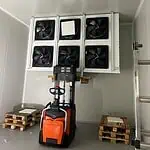
- Forced convection evaporators (fan-cooled evaporators): These use fans to move air more quickly and efficiently, typically used in industrial refrigeration systems.
- Plate evaporators: These systems have a compact design due to refrigerant flowing between plates. They are highly energy-efficient and are commonly used in industrial applications.
- Flooded evaporators: These evaporators have refrigerant completely immersed in liquid and are often used in large capacity systems.
What to consider when choosing an evaporator?
When choosing an evaporator, the following factors should be considered:
- Capacity: Choose an evaporator with appropriate capacity based on the space requirements.
- Energy efficiency: It is best to choose models that offer maximum cooling with minimal energy consumption.
- Ease of maintenance: Evaporators that are easy to clean and maintain offer long-term advantages.
- Material quality: It is recommended to choose evaporators made from durable materials such as stainless steel or aluminum.
Conclusion
Evaporators are essential components of refrigeration systems and can be used effectively in various fields due to their different types. It is important to choose a suitable evaporator to ensure optimal system performance and efficient cooling.